A mammogram can find breast cancer years before you would ever feel it. This guide explains when to go, what the results and numbers mean and who can help.
It is written for women, and for the daughters, sisters and friends who remind them to go. It does not replace your doctor. Use it to walk into that appointment with better questions.

When to get screened
Two trusted groups set screening guidance in the United States, and they agree on the most important point: most women should be getting regular mammograms in their 40s. They differ on when exactly to start and how often to go.
| Age | U.S. Preventive Services Task Force3 | American Cancer Society2 |
|---|---|---|
| 40 to 44 | A mammogram every other year | You may choose to start with a mammogram every year |
| 45 to 54 | A mammogram every other year | A mammogram every year |
| 55 to 74 | A mammogram every other year | Every other year, or keep going every year |
| 75 and older | Not enough evidence to recommend for or against | Continue while in good health and expected to live at least 10 more years |
Which one is right for you? That is a conversation to have with your doctor. What matters most is that you start, and that you keep going.
This guidance is for women at average risk. If breast cancer runs in your family, read family history and genetic risk first.
Mammograms are not perfect. Some cancers are missed, and some women are called back for more tests that turn out fine. The American Cancer Society is clear that regular screening is still the most reliable way to find breast cancer early.2
What "found early" means
Doctors track breast cancer by how far it has spread when it is first found. The earlier the stage, the better the outlook. These are the five-year relative survival rates for women diagnosed between 2015 and 2021.1
| Stage | What it means | Rate |
|---|---|---|
| Localized | No sign the cancer has spread outside the breast | over 99% |
| Regional | Spread to nearby tissue or lymph nodes | 87% |
| Distant | Spread to other parts of the body, such as the lungs, liver or bones | 32% |
| All stages | Every stage combined | 92% |
When people say breast cancer "found early," they usually mean the localized stage. That is the stage a regular mammogram gives you the best chance of catching.
What the numbers cannot tell you
A survival rate is an average across many thousands of women. It is not a prediction for any one person. Four things are worth knowing before you lean on it.1
- Relative means compared. A rate of over 99 percent means women with localized breast cancer are, on average, about as likely to be alive five years later as women without it. It is a comparison, not a promise.
- The localized figure counts invasive cancer only. It does not include DCIS, a non-invasive condition often found on mammograms.
- The rates describe the stage at diagnosis. They do not change later if the cancer grows or returns.
- They look backward. They come from women diagnosed years ago, and treatment keeps improving. Some types, such as triple-negative and inflammatory breast cancer, have different rates.
Your own outlook depends on your age, your health, the type of cancer and how it responds to treatment. Your care team can speak to that. A chart cannot.
If you notice a change
Know how your breasts normally look and feel. If something changes, such as a new lump, a change in the skin or nipple or anything that simply feels different to you, tell a doctor right away.2 Do not wait for your next scheduled mammogram.
Getting checked is how you find out what a change means. Asking is never an overreaction.
Family history and genetic risk
Some women carry a higher risk. That includes women with a strong family history of breast cancer and women with a known change in a BRCA1 or BRCA2 gene. It also includes women whose mother, sister or daughter has one of those gene changes and women who had radiation to the chest before age 30.2
For women at high risk, the American Cancer Society recommends a breast MRI and a mammogram every year, usually starting at age 30, decided together with a doctor.2
If cancer runs in your family, say so at your next appointment, and ask whether genetic counseling makes sense for you. Include both sides of the family. Your father's relatives count too.2
Questions to ask your doctor
Write these down, or bring this page with you.
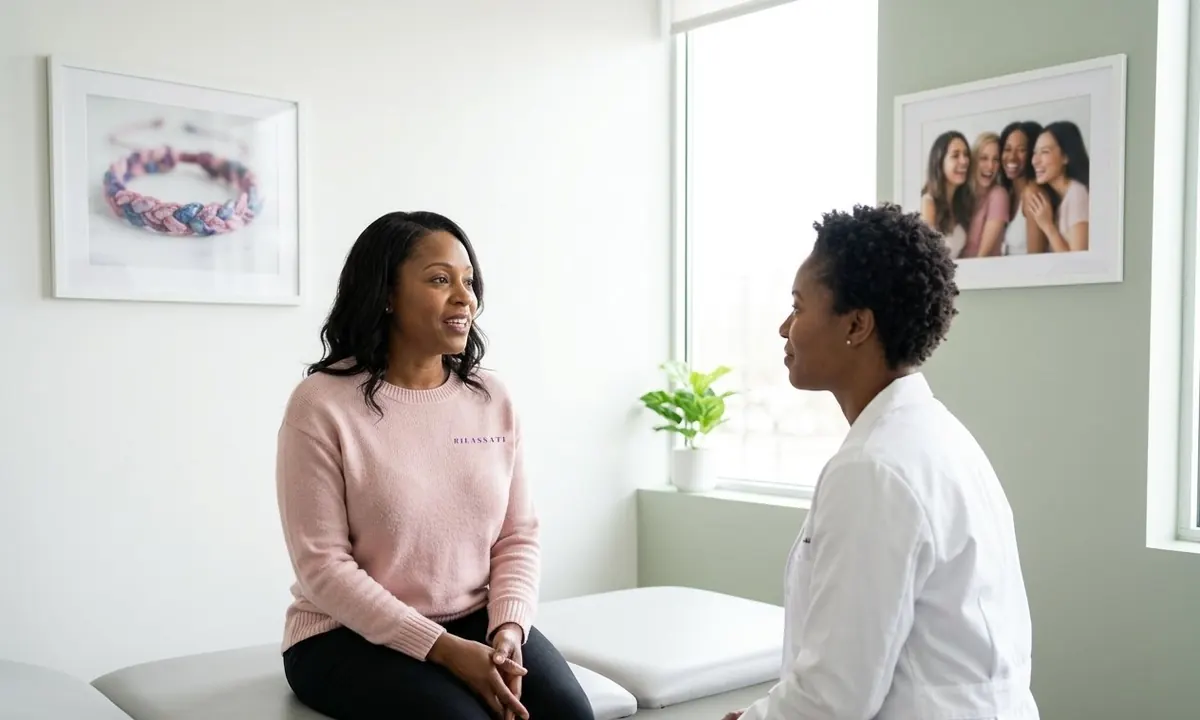
- Am I at average risk or higher risk?
- When should I start, and how often should I go?
- Does my family history change my plan?
- Should I talk to a genetic counselor?
- What does my mammogram report say about breast density?
- If I get called back, what happens next?
Getting screened close to home
Your doctor or clinic can order a mammogram and tell you where to go. If cost is standing in the way, tell them, and ask what help is available.
The money Winners For Life raises for mammograms goes to Gift of Life in Beaumont, which screens women right here at home.
The American Cancer Society helpline can also point you to resources, any hour of the day or night.4
1.800.227.2345American Cancer Society, 24 hours a day

Rilassati was founded by Tracey Young, a registered nurse. Her mother, Dr. Winifred Frelow, started Winners For Life in 2002 so women in Port Arthur would not face breast cancer alone.
Sources
- American Cancer Society. Survival Rates for Breast Cancer. Based on NCI SEER data for women diagnosed 2015 to 2021, with reference to Cancer Facts and Figures 2026. Last revised July 23, 2026. cancer.org
- American Cancer Society. Recommendations for the Early Detection of Breast Cancer. Last revised July 23, 2026. cancer.org
- U.S. Preventive Services Task Force. Screening for Breast Cancer: Recommendation Statement. JAMA, 2024, 331:1918 to 1930. Published April 30, 2024. uspreventiveservicestaskforce.org
- American Cancer Society. Contact Us, 24/7 cancer helpline. Checked September 15, 2026. cancer.org
This guide shares general health information. It is not medical advice. Talk with your doctor about your own care.